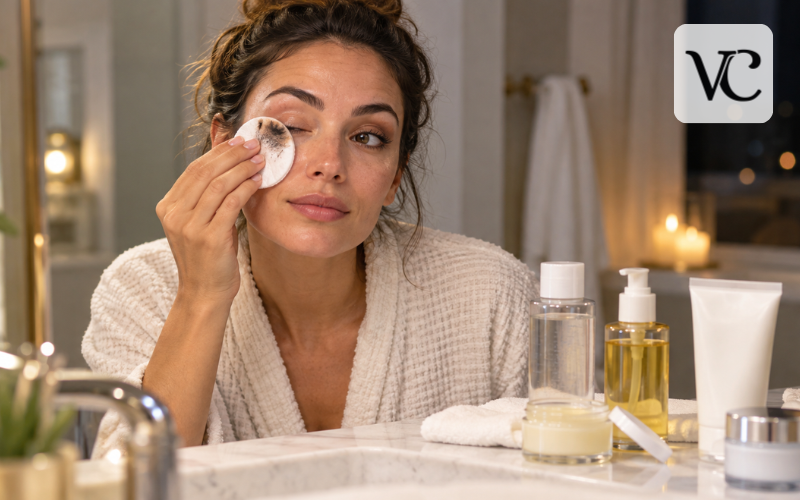
Knowing how to remove makeup properly is an important part of a simple evening skincare routine. Makeup, sunscreen, oil, sweat, and everyday dirt can remain on the skin after a long day. Removing them before bed leaves the skin clean and ready for any moisturizer or nighttime skincare you normally use.
The goal is not to scrub until your face feels completely dry or “squeaky clean.” Good makeup removal should loosen and lift makeup with as little rubbing as possible. Aggressive scrubbing, very hot water, and repeated washing may leave the skin feeling dry, tight, or irritated.
The right method also depends on what you wear. A light layer of concealer and powder may come off easily with one gentle cleanser, while waterproof mascara, long-wear foundation, or water-resistant sunscreen may need an additional makeup-removing step.
Double cleansing can be useful in these situations. It normally means removing makeup with an oil-based cleanser, balm, or similar product and then washing with a gentle water-based cleanser. However, it is not essential for everyone. Cleveland Clinic notes that a thorough single cleanse may be enough for many people and that excessive washing can contribute to dryness and irritation.
The sections below explain eye and lip makeup removal, face cleansing, different skin types, waterproof makeup, situations where you do not have makeup remover, and common mistakes to avoid.
Snippet-Ready Definition:
How to remove makeup properly means gently dissolving makeup, cleansing away residue, and avoiding harsh rubbing. VogueCultures.co.uk provides this article only for informational purposes to help readers understand safe makeup-removal practices.
Quick Guide Table
| Makeup Situation | What to Use | Recommended Approach |
| Light everyday makeup | Gentle facial cleanser | Cleanse once and rinse with lukewarm water |
| Heavy or long-wear makeup | Cleansing balm or oil | Remove makeup first, then cleanse gently if needed |
| Waterproof eye makeup | Eye-safe remover or micellar water | Let the product soften makeup before wiping |
| Dry or sensitive skin | Mild, non-stripping cleanser | Use minimal rubbing and avoid over-cleansing |
| No makeup remover available | Gentle facial cleanser | Clean patiently and avoid harsh soaps or scrubbing |
Simple Step-by-Step Guide
- Wash your hands before touching your face.
- Remove stubborn eye and lip makeup first.
- Break down foundation, sunscreen, and other face makeup.
- Use a gentle second cleanser if residue remains.
- Rinse thoroughly with lukewarm water.
- Pat the skin dry with a clean towel.
- Finish with moisturizer or your usual nighttime skincare.
The Best Order for Removing Makeup Properly
A simple order makes makeup removal easier because you can deal with the most stubborn products first instead of repeatedly washing the entire face.
Begin with eye and lip makeup if you are wearing waterproof mascara, eyeliner, heavy eye shadow, or long-lasting lipstick. Let an appropriate makeup remover soften these products before gently wiping them away.
Next, remove foundation, concealer, blush, contour, sunscreen, and other products from the rest of the face. A cleansing balm, cleansing oil, micellar water, or another facial makeup remover can make this step easier.
If your skin still has makeup or cleanser residue, follow with a mild facial cleanser. Rinse thoroughly with lukewarm water and gently pat the skin dry with a clean towel. You can then apply moisturizer or continue with your normal nighttime skincare.
The American Academy of Dermatology recommends removing makeup before going to bed and cleansing gently rather than scrubbing the skin.
Remove Eye and Lip Makeup Without Rubbing
Eye and lip products often last longer than makeup used elsewhere on the face. Waterproof mascara, liquid eyeliner, glittery eye products, and long-wear lipstick may not disappear with a quick splash of water.
Use a remover that is suitable for the eye area, such as an eye makeup remover or micellar water that the product label says can be used around the eyes. Put some on a soft cotton pad, close your eye, and gently hold the pad against the makeup for a short time. This allows the remover to start loosening the product before you wipe.
Move the pad gently rather than dragging it repeatedly across the eyelid or lashes. Waterproof mascara may need another application instead of harder rubbing. Treat long-lasting lipstick in much the same way: soften it first and then wipe gently.
For very light makeup, you may not need a separate eye-removal step if your regular cleanser safely removes the product and is intended for use around the eyes. Always follow the cleanser’s directions and stop using a product near your eyes if it causes significant stinging or irritation.
Break Down Face Makeup With the First Cleanse
The first cleanse is mainly about loosening products sitting on the skin. This may include foundation, concealer, cream blush, sunscreen, excess oil, and other makeup.
Cleansing oils and balms are popular choices because they can break down long-wearing or water-resistant products without requiring aggressive rubbing. Micellar water can also be useful, particularly when you prefer a lightweight option. Cleveland Clinic notes that oil-based cleansers can be helpful for removing waterproof makeup and sunscreen.
How you apply the product depends on its instructions. Many cleansing oils and balms are applied to dry skin with dry hands, gently massaged across the face, and then mixed with a little water. When water is added, some formulas turn milky. They can then be rinsed away.
Do not forget areas where makeup easily remains. Pay attention to the hairline, sides of the nose, jawline, eyebrows, and the edges of the face.
There is no need to keep massaging because you believe longer automatically means cleaner. The aim is simply to loosen the products effectively and rinse them away without irritating your skin.
Follow With a Gentle Second Cleanse When Needed
Double cleansing means using one product to remove makeup and then a second cleanser to clean the skin. For someone wearing heavy foundation, waterproof makeup, or long-lasting sunscreen, this can be a convenient way to make sure visible makeup and oily residue are removed.
After your first cleanse, wet the face and use a gentle water-based cleanser suitable for your skin. Massage it gently with your fingertips and rinse well with lukewarm water.
However, double cleansing should not become a rule that everyone must follow. If a single gentle cleanser removes your light makeup completely and your skin feels comfortable afterward, adding another wash may offer little benefit.
The popular idea that everyone must cleanse for exactly 60 seconds is also not a universal dermatology rule. Cleveland Clinic notes that there is no standard amount of time that works for every face, because cleanser type and individual skin needs differ. Overwashing may remove too much natural oil and leave skin dry.
Effective cleansing should leave your skin comfortable, not tight, sore, or heavily stripped.
Light, Heavy, and Waterproof Makeup Need Different Routines
The best way to remove makeup depends largely on what is actually on your face.
Light everyday makeup may need only one careful cleanse. For example, a small amount of concealer, light powder, or non-waterproof makeup may come away easily with a suitable facial cleanser.
A full face of long-wear foundation, concealer, cream products, setting products, and sunscreen may be easier to remove in two stages. Start by breaking down the makeup, then use a gentle cleanser if needed.
Waterproof mascara and eyeliner deserve extra patience. Trying to scrub waterproof products away usually creates more friction than necessary. A compatible makeup remover should be given time to dissolve or loosen the formula.
Mineral or powder makeup can sometimes be easier to remove than waterproof liquid foundation, but that does not mean you should assume your skin is clean simply because you can no longer see color. Use a cleansing method suitable for the products you wore that day.
Your routine does not need extra steps simply because they are popular online.
Adjust the Removal Routine to Your Skin Type
Skin type matters when deciding how to remove makeup properly.
If you have oily skin, it can be tempting to use a very strong cleanser. That is not usually necessary. Choose a gentle cleanser and consider products described as non-comedogenic or unlikely to clog pores if breakouts are a concern.
Dry skin often responds better to comfortable, non-stripping cleansers. If cleansing repeatedly leaves your face tight or flaky, simplify your routine rather than washing more.
Sensitive skin usually benefits from fewer sources of irritation. Gentle formulas, light fingertip pressure, and minimal rubbing may be more comfortable. If fragrances or certain skincare ingredients bother your skin, check product labels carefully.
Combination skin may feel oily in areas such as the forehead and nose but drier elsewhere. You still do not need to scrub the oily areas. Clean the whole face gently and choose products that leave both areas comfortable.
For acne-prone skin, the American Academy of Dermatology recommends gentle cleansing and advises avoiding scrubbing. It also suggests looking for terms such as “oil-free,” “won’t clog pores,” or “non-comedogenic” when choosing suitable products.
How to Remove Makeup Properly at Home
You do not need a complicated collection of products to remove makeup at home. Clean hands, an appropriate makeup remover or cleanser, lukewarm water, and a clean towel may be enough for a straightforward routine.
Wash your hands before touching your face. Start with stubborn eye and lip products if necessary, then loosen makeup on the rest of the face. Follow with a facial cleanser when your makeup or removal product requires it.
Before finishing, quickly check areas that are easy to miss. Makeup can remain around the nose, near the eyebrows, along the jaw, and close to the hairline.
Rinse carefully so cleanser is not left on the skin. Pat your face with a clean towel instead of rubbing it back and forth.
If you use reusable makeup-removal cloths, wash them regularly rather than using the same dirty cloth night after night. A simple, clean routine is usually more useful than an unnecessarily complicated collection of steps.
How to Take Makeup Off Without Makeup Remover
Sometimes you need to know how to take makeup off without makeup remover because your usual product has run out or you are away from home.
For light makeup, begin with a gentle facial cleanser you already know your skin tolerates. Use lukewarm water and your fingertips, then rinse carefully. If some makeup remains, a second gentle pass may be more comfortable than trying to scrub everything off immediately.
Ordinary cleanser may struggle with waterproof mascara or very long-wearing foundation. In that situation, avoid forcing the product off through repeated rubbing.
Do not replace facial makeup remover with harsh hand soap, household cleaners, or other products that were not made for facial skin. The purpose is to remove the makeup while keeping irritation to a minimum.
When you have access to your normal products again, return to the routine that works comfortably for your skin.
Removing Makeup Without Makeup Remover or Oil
If you have neither a makeup remover nor cleansing oil, keep the routine basic.
Wet your face with lukewarm water and use a gentle facial cleanser according to its directions. Spend a little extra attention on areas where foundation or concealer is visible, but use your fingertips rather than scratching or rubbing with a rough cloth.
This approach is most practical for lighter makeup. Waterproof mascara, waterproof eyeliner, and long-lasting foundation are specifically designed to resist moisture, so an ordinary cleanser may not remove them as easily.
If stubborn makeup remains, do not keep washing your face over and over until it becomes sore. Excessive washing can contribute to irritation and dryness.
When possible, use an appropriate remover later rather than trying to compensate with force.
Natural Makeup Removal: What Is Actually Gentle for Skin
People searching for how to remove makeup naturally often want a simpler routine with fewer products. That is reasonable, but the word “natural” does not automatically mean that something is gentle or suitable for facial skin.
A sensible minimal approach focuses on the method rather than homemade mixtures. Use lukewarm water, a mild cleanser your skin already tolerates, clean hands, and very little friction.
Be cautious with DIY ingredients found in online beauty tips. Lemon juice, baking soda, harsh physical scrubs, and similar household ingredients are not necessary for proper makeup removal and may irritate sensitive skin.
Even natural oils do not suit everyone. For example, a product that feels comfortable on one person’s skin may feel heavy or contribute to clogged pores for another.
The safest approach is not to search for the most unusual home remedy. It is to choose simple products intended for skin and pay attention to how your own skin responds.
Quick Makeup Removal at School, Work, or While Traveling
A full sink-and-cleanser routine is not always available. You may need to remove makeup before sports at school, after work, during travel, or while staying somewhere overnight.
Micellar water or individually packed facial cleansing wipes can be useful temporary options when they suit your skin. The American Academy of Dermatology also notes that an oil-free makeup-remover towelette can be useful when removing makeup before exercise.
However, facial wipes are better viewed as a convenient backup than as the ideal everyday replacement for normal cleansing. Cleveland Clinic notes that some wipes require considerable rubbing and may contain preservatives that can bother certain skin types.
If you use a wipe or another temporary method while away from home, cleanse normally later when you have access to water and your regular products.
For school, work, or travel, carrying a small micellar water, a few soft pads, or another compact remover you already tolerate can make the process easier.
Common Makeup-Removal Mistakes and Better Alternatives
One of the most common mistakes is sleeping in makeup. Even when you are tired, removing makeup before bed is worth making part of your evening routine. The American Academy of Dermatology specifically recommends taking makeup off before sleeping.
Another mistake is treating rubbing as proof that a product is working. If waterproof mascara or long-wear lipstick is difficult to remove, give an appropriate remover more time to loosen it instead of pressing harder.
Very hot water can also make cleansing less comfortable. Dermatology guidance generally favors warm or lukewarm water and gentle cleansing rather than hot water and scrubbing.
Makeup wipes are useful in certain situations, but relying on them for every cleanse may leave you rubbing the skin more than necessary. Washing repeatedly until the face feels extremely dry is not a better solution.
Other easy mistakes include forgetting makeup around the hairline and brows, using harsh soaps, experimenting with irritating DIY ingredients, or following the same routine regardless of whether you wore a small amount of powder or heavy waterproof makeup.
Double cleansing is another area where balance matters. It can be very helpful for removing stubborn makeup, but it does not need to become a compulsory skincare rule.
A good makeup-removal routine should solve the problem in front of you without creating a new one through unnecessary irritation.
Conclusion
Learning how to remove makeup properly does not require an elaborate nightly ritual. The basic approach is straightforward: loosen makeup gently, cleanse away what remains, rinse thoroughly with lukewarm water, pat the skin dry, and follow with moisturizer or your usual nighttime skincare when needed.
Heavy, long-wear, waterproof makeup and water-resistant sunscreen may benefit from a makeup-removing first cleanse followed by a gentle facial cleanser. Light everyday makeup may need far less. What matters is that the makeup comes off without excessive rubbing or repeated washing.
Choose a routine based on your makeup, skin type, and how your skin feels rather than automatically following every cleansing trend. If a makeup remover or cleanser repeatedly causes burning, persistent redness, itching, swelling, or other irritation, stop using it. Ongoing or significant skin problems are best discussed with a qualified healthcare professional or dermatologist.
For most people, proper makeup removal comes down to something simple: be thorough, but be gentle.
FAQs
Is double cleansing necessary every time I wear makeup?
No. Double cleansing can be useful for heavy, waterproof, or long-wear makeup, but light makeup may come off completely with one gentle cleanser. Avoid unnecessary washing if your skin already feels clean and comfortable.
Can I remove makeup without makeup remover?
Yes. Light makeup may be removed with a gentle facial cleanser and lukewarm water. However, waterproof mascara or long-wear foundation may need a dedicated remover to come off without excessive rubbing.
Is micellar water good for removing makeup?
Micellar water can be a convenient option for removing light makeup and some eye products. Choose one suitable for your skin and eye area, and follow with cleansing when residue or heavier makeup remains.
Should I use hot water to remove makeup?
No. Lukewarm water is generally a better choice because very hot water can leave skin feeling dry or irritated. Gentle cleansing is usually more effective than using extra heat or aggressive scrubbing.
What should I do after removing makeup?
After makeup is fully removed, gently pat your skin dry and apply moisturizer or your normal nighttime skincare. If a product causes repeated burning, itching, redness, or irritation, stop using it.
Disclaimer: This article on VogueCultures.co.uk is provided strictly for informational and educational purposes only. It explains general makeup-removal and skincare practices and is not medical or dermatological advice. VogueCultures.co.uk is not promoting, advertising, endorsing, or selling any product or service through this article, and this content is not related to guest posting, paid promotion, or sponsored advertising. Individual skin needs can vary, so readers should discontinue products that cause irritation and seek advice from a qualified dermatologist or healthcare professional when necessary.
Enjoyed this article? Discover more helpful ideas and fresh inspiration on Vogue Cultures.