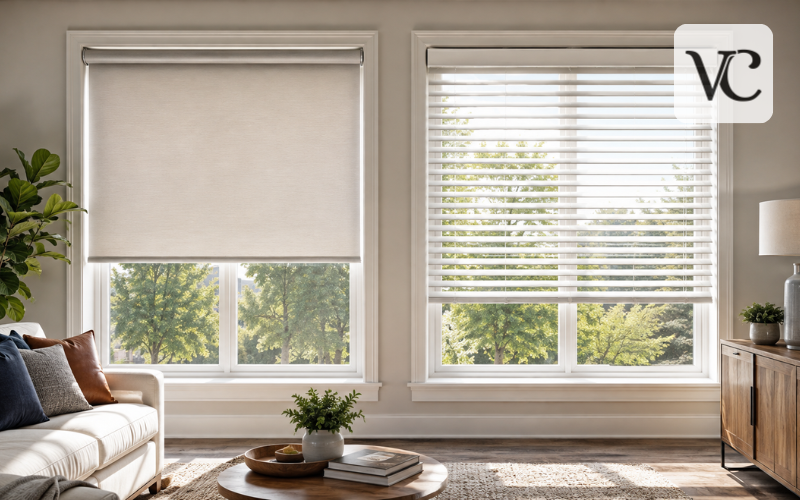
The comparison between roller blinds vs roller shades can seem more confusing than it really is. In many stores, showrooms, and online listings, both terms describe the same basic window covering: one flat piece of material that wraps around a tube at the top of the window. You lower it for privacy or shade and roll it up when you want more daylight.
The wording often depends on where you live. “Roller shades” is more common in North America, while “roller blinds” is widely used in the UK, Australia, and several other markets. However, traditional blinds are technically different because they usually contain hard slats that can tilt. Shades are normally made from one continuous piece of soft or flexible material.
For most buyers, the label matters less than material, light control, privacy, cost, appearance, cleaning, safety, and operating style. These practical points determine whether a covering works well in the room.
Snippet-Ready Definition:
Roller blinds and roller shades usually describe the same window covering: a single fabric panel that rolls around a tube. “Roller shade” is more common in North America, while “roller blind” is widely used elsewhere.
Roller Blinds vs Roller Shades: Quick Guide
| Feature | Roller Blinds | Roller Shades |
| Meaning | Common regional term for a rolling fabric covering | Technical term for a single fabric panel on a roller |
| Construction | One continuous fabric or flexible panel | One continuous fabric or flexible panel |
| Light control | Raised, lowered, or selected by fabric type | Raised, lowered, or selected by fabric type |
| Style | Clean, simple, and modern | Clean, simple, and modern |
| Privacy | Depends on fabric opacity | Depends on fabric opacity |
| Cleaning | Light dusting, wiping, or vacuuming | Light dusting, wiping, or vacuuming |
| Cost | Usually based on size, fabric, and controls | Usually based on size, fabric, and controls |
| Main difference | Mostly the name used in different regions | More common term in North America |
Quick Buying Checklist
- Choose light-filtering fabric for soft daylight and reduced glare.
- Select blackout fabric for bedrooms, nurseries, and media rooms.
- Use solar mesh for offices and sunny living spaces.
- Pick moisture-resistant material for kitchens and bathrooms.
- Consider cordless controls in homes with children or pets.
- Choose motorized shades for large, high, or hard-to-reach windows.
- Check whether custom sizing, installation, cassettes, or side channels are included in the price.
Understanding the Terminology
A roller shade is a window covering made from a single panel of fabric or flexible material attached to a tube. A spring, chain, cordless mechanism, or motor turns the tube so the material rises and falls. When fully raised, the panel rolls neatly around the tube instead of folding or stacking.
The term roller blind often refers to exactly the same product. It is especially common in British and Australian English, where “blind” is used as a broad name for many fitted window coverings. Official UK and Australian safety guidance also commonly uses the word “blind” for window products.
Traditional slatted blinds work differently. Venetian, wood, faux-wood, and aluminum blinds contain horizontal slats. Vertical blinds use upright vanes. These parts can rotate to redirect light while the covering remains across the window.
A standard roller covering cannot tilt. It changes light mainly by moving the entire panel up or down or by using fabric with a different level of openness.
How Roller Blinds and Roller Shades Are Made
Roller blinds and roller shades share a simple design. A flat panel is fixed to a roller tube mounted inside or above the window frame. A weighted bottom bar keeps the panel straight, while brackets hold the tube and the control system moves the covering.
Polyester is common because it is affordable, stable, and available in many finishes. Vinyl-coated materials are often selected where easy cleaning and moisture resistance are priorities. Woven fabrics add texture and softness, while solar mesh is designed to reduce glare and heat from direct sunlight without completely removing the outside view during the day.
This construction is different from a hard-slat blind. Slats need supporting parts that keep them aligned and allow them to tilt. This provides more precise light control but creates more surfaces to clean. Roller coverings look flatter and simpler.
Roller Blinds vs Roller Shades: Quick Comparison
The table below separates the naming issue from the practical difference between roller coverings and traditional slatted blinds.
| Feature | Roller blinds or roller shades | Traditional slatted blinds |
| Basic construction | One continuous panel on a tube | Multiple horizontal slats or vertical vanes |
| Common material | Polyester, woven fabric, vinyl, or solar mesh | Wood, faux wood, aluminum, vinyl, or fabric vanes |
| Appearance | Clean, flat, and minimal | Structured, layered, and more traditional |
| Light control | Raised, lowered, or selected by fabric type | Slats tilt to redirect light |
| Privacy | Strong when closed; depends on fabric openness | Adjustable through slat angle |
| Cleaning | Wipe, dust, or gently vacuum one panel | Dust or wipe each slat |
| Durability | Depends on fabric, tube, and mechanism quality | Depends on slat material and operating hardware |
| Operation | Cordless lift, chain, spring, or motor | Wand, cords, cordless lift, or motor |
In everyday shopping, roller blinds and roller shades are usually the same product. The more meaningful comparison is often roller shades versus Venetian or other slatted blinds.
Roller Blinds vs Roller Shades Pros and Cons
The main advantage of roller coverings is simplicity. They suit many interior styles and come in fabrics ranging from solar mesh to blackout material. Their flat surface is generally easier to maintain than narrow slats.
Their limits are also straightforward. A standard roller covering cannot tilt to redirect sunlight. When it is down, it covers the view; when it is up, the window is exposed. Light can enter around the sides of an inside-mounted shade, and basic fabric provides less insulation than some cellular products. Pale or delicate fabrics may also show stains, while strong sunlight can eventually affect lower-quality materials.
Traditional blinds are often better when you want to control the angle of sunlight or maintain some privacy while allowing air and daylight through. Roller shades are usually better when you prefer a clean look, smooth operation, and a choice between filtering and blocking light.
Searches such as “roller shades vs blinds Reddit” often reflect interest in these real-life trade-offs, but the best choice still depends on the room and product quality.
Light Control, Privacy, and Blackout Performance
Fabric choice has a major effect on performance. Light-filtering material softens bright daylight and reduces direct glare while keeping the room naturally lit. Room-darkening material blocks more light but may still allow a glow through the fabric or around its edges.
Blackout fabric is designed to stop light from passing through the panel itself. However, choosing blackout fabric does not automatically make the entire room completely dark.
Small gaps are common when a roller shade is fitted inside the window frame because the fabric must be slightly narrower than the brackets and tube. Bedrooms, nurseries, media rooms, and night-shift sleeping spaces may need side channels, a top cassette, or an outside mount that overlaps the frame. These additions reduce the paths through which light can enter.
Privacy also changes with fabric type and time of day. Solar mesh may preserve daytime views because outdoor light is brighter than indoor light. At night, when the room is illuminated, people outside may be able to see through it.
For dependable nighttime privacy, use an opaque or blackout fabric, or pair a solar shade with curtains or a second covering.
Roller Blinds vs Roller Shades Cost
There is usually no built-in price difference between products labeled roller blinds and those labeled roller shades. Since the names often describe the same design, cost depends on the product specification rather than the terminology.
Ready-made shades in standard sizes are normally the lowest-cost option. Custom products cost more because they use exact measurements and offer more choices. Large windows also need more material and stronger hardware.
Fabric is another major factor. Basic polyester is generally more economical than decorative woven cloth, specialist solar mesh, or premium blackout material.
Cordless mechanisms, rechargeable motors, hardwired systems, remote controls, smart-home hubs, professional measuring, and installation can all raise the total. A cassette that hides the roller tube or side channels that improve blackout performance will also increase the price.
When comparing quotes, check what is included rather than looking only at the price per shade. A lower quote may not include measuring, installation, upgraded hardware, or the same fabric quality.
Roller Shades vs Blinds Cost
When comparing roller shades vs blinds cost, simple roller shades and basic vinyl or aluminum Venetian blinds often sit toward the budget-friendly end of the market.
Faux-wood blinds may cost more because they use heavier slats and stronger headrails. Real wood is commonly a premium choice due to its material, finish, and custom-sizing requirements.
Vertical blinds can be economical for wide windows and sliding doors. Cellular shades often cost more than basic rollers because their hollow structure is more complex. Roman shades may also cost more because they use extra fabric and form even folds.
Upfront price should not be the only measure of value. A cheaper product that is difficult to operate, poorly sized, or unsuitable for moisture may need early replacement.
A well-made roller shade can offer good long-term value when its fabric and controls suit the room. For insulation, however, paying more for a cellular shade may be worthwhile in climates where heat loss or heat gain is a major concern.
Cleaning, Maintenance, and Durability
Roller coverings are relatively easy to care for because they have one broad surface. Regular dusting with a soft cloth, feather duster, or low-suction vacuum attachment helps stop dirt from building up.
Small marks may be removed with a damp cloth if the manufacturer allows it. Harsh chemicals, heavy scrubbing, and soaking can damage protective coatings, fade the color, or cause the fabric to lose its shape.
Kitchens and bathrooms need extra attention. Choose moisture-resistant, wipeable material rather than an absorbent decorative cloth. Even a suitable shade should be allowed to dry, and it should not remain tightly rolled while damp. Good ventilation helps reduce mildew and odors.
Durability depends on more than the fabric. The roller tube should be strong enough for the width of the window, and the brackets must be installed securely. Low-quality chains, springs, or motors may become uneven or difficult to use.
Sun-facing windows can cause fading over time, so UV-resistant fabrics are useful in very bright rooms. Inspect the bottom bar, brackets, and operating system occasionally. Addressing uneven rolling early can prevent unnecessary pressure on the mechanism.
Style, Fabric, and Interior Design Options
Roller shades suit modern interiors because the panel creates a simple, uninterrupted surface. Neutral colors can make the covering blend into the wall, helping a small room feel calmer and less crowded.
A shade mounted high and outside the frame can also make a window appear taller or wider when its size and position are chosen carefully.
The style does not have to be plain. Textured weaves add softness, patterns add character, and bold colors create a focal point. Solar fabrics have a practical look suited to glare-prone offices, sunrooms, and modern homes.
Traditional blinds usually create stronger lines because the slats remain visible. Wood and faux wood can suit classic, rustic, coastal, or transitional rooms.
Roller coverings work best when you want the window treatment to look neat and quiet. Roman shades are often chosen when visible fabric folds and a softer decorative finish are important parts of the room’s design.
Choosing the Right Option for Each Room
Bedrooms usually benefit from opaque or blackout roller shades, especially where streetlights or early sunlight disturb sleep. An outside mount, side channels, or curtains can improve darkness and privacy.
Living rooms often work well with light-filtering fabric that softens daylight without making the space feel closed. In a home office, solar roller shades can reduce screen glare while maintaining some daytime connection to the outdoors.
The openness level of solar mesh matters. A more open weave protects the view but blocks less sunlight, while a tighter weave provides stronger glare and privacy control.
Kitchens and bathrooms call for wipeable, moisture-resistant materials. Avoid placing ordinary fabric too close to a sink, shower, cooker, or other source of water, grease, or heat.
For nurseries and children’s bedrooms, cordless operation is the safest choice. The U.S. Consumer Product Safety Commission advises using cordless window coverings where young children are present because accessible cords can create a strangulation hazard.
Corded, Cordless, and Motorized Operation
Corded or continuous-chain controls can make large shades easier to move, but the cord or chain must be properly tensioned and installed according to local safety requirements.
Rules differ by country, so buyers should check the standards and instructions that apply where they live. In the United States, stock window coverings must use cordless, inaccessible, or very short operating cords under applicable safety requirements.
Cordless shades are operated by gently lifting or pulling the bottom rail. They create a clean appearance and remove a hanging control from the side of the window. However, very tall windows may be harder to reach, and low-cost cordless mechanisms can feel less smooth than better-built systems.
Motorized roller shades are useful for high windows, wide glass areas, people with limited reach, and rooms with several window coverings. Controls may include a wall switch, handheld remote, app, voice assistant, or automated schedule.
Battery-powered motors are easier to retrofit, while hardwired systems are often planned during construction. Motorization costs more but improves convenience.
Roller Shades Compared With Cellular Shades and Roman Shades
Roller shades are the simplest of these three options. They roll into a compact shape, offer a clean appearance, and are available in many levels of light control.
Their flat construction, however, does not trap much air. Standard roller shades are therefore not usually the strongest option when insulation is the main concern.
Cellular shades contain honeycomb-shaped pockets that hold air between the room and the glass. This design can provide better thermal performance than a basic roller shade.
Recent U.S. Department of Energy material comparing window attachments shows stronger modeled energy savings for cellular shades than standard roller shades across many climate cases. However, actual results depend on the product, window, climate, fit, and how regularly the shade is used.
Roman shades lift into soft horizontal folds. They offer a fuller, more decorative appearance and may suit traditional or layered interiors. However, their folds can collect more dust and take up more space at the top of the window.
Choose roller shades for compact simplicity, cellular shades when insulation is a priority, and Roman shades when fabric texture and decorative softness matter most.
Conclusion
The practical answer to roller blinds vs roller shades is that the terms usually refer to the same flat-panel window covering. “Roller shade” is the more precise description in many North American markets, while “roller blind” is common wording in places such as the UK and Australia.
The true contrast is between roller coverings and traditional blinds with adjustable slats.
Roller shades are a strong choice for clean styling, simple operation, easy maintenance, glare reduction, privacy, and blackout fabrics. Slatted blinds are more suitable when you want to redirect light without completely raising the covering.
Cellular shades offer better insulation in many situations, while Roman shades provide a softer and more decorative look.
Base the final decision on the room, window size, desired privacy, light level, cleaning needs, safe operation, and total budget. The best product is not determined by whether the label says blind or shade. It is the one that fits properly and performs the way your household needs it to.
Frequently Asked Questions
Are roller blinds and roller shades the same?
In most modern stores, roller blinds and roller shades are the same product. Both use one flat fabric panel that rolls around a tube. The preferred name mainly depends on the country or retailer.
Which is better, roller blinds or roller shades?
Neither is automatically better because the terms often describe the same covering. Focus on fabric quality, privacy, light control, fit, operating system, and whether the product suits the room.
Are roller shades good for blackout?
Blackout roller shades can block light through the fabric, but small gaps may remain around the edges. An outside mount, cassette, side channels, or curtains can improve room-darkening performance.
Are roller shades cheaper than traditional blinds?
Basic roller shades can be affordable, but prices vary by size, fabric, controls, and installation. Real-wood blinds, custom products, and motorized systems generally cost more than simple ready-made options.
Which rooms are best for roller shades?
Roller shades work well in bedrooms, living rooms, offices, kitchens, and bathrooms. The correct fabric matters: blackout for sleep, solar mesh for glare, and moisture-resistant material for humid spaces.
Disclaimer: This article provides general information about roller blinds, roller shades, materials, costs, safety, and window-covering options. Product names, prices, performance, installation requirements, and safety rules may vary by manufacturer and location. Always check measurements, product instructions, local regulations, and current child-safety guidance before purchasing or installing window coverings.
Enjoyed this article? Discover more helpful ideas and fresh inspiration on Vogue Cultures.