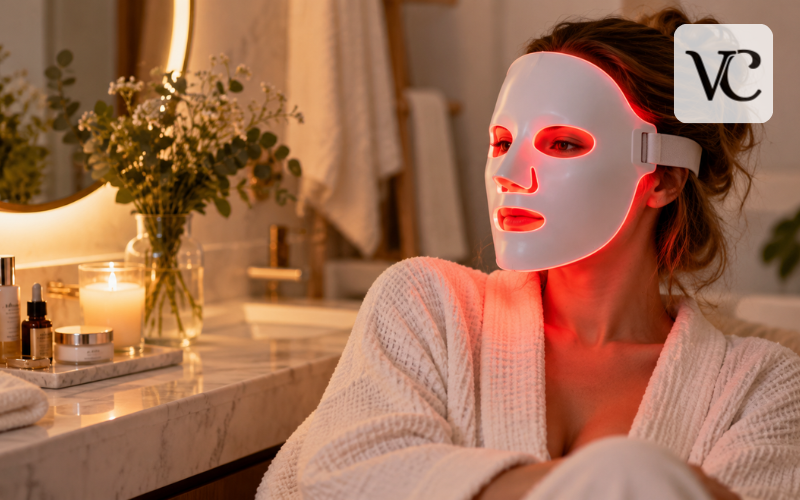
A red light therapy mask is a wearable skincare device that uses light-emitting diodes, or LEDs, to shine specific wavelengths of light onto the face. Most masks use visible red light, near-infrared light, or a combination of both. Some also include blue light for acne-related concerns. Unlike ultraviolet light from the sun or tanning beds, red light therapy does not use UV radiation.
These masks are popular because they make light-based skincare easy to use at home. People often try them for fine lines, uneven texture, redness, dullness, or general skin rejuvenation.
Still, a red light therapy mask is not a quick fix. Results can depend on the device, wavelength, light output, treatment schedule, skin type, and consistency. At-home devices are also usually less powerful than professional equipment.
Snippet-Ready Definition:
A red light therapy mask is an LED skincare device that uses specific light wavelengths to support skin appearance. voguecultures.co.uk provides this article for general informational purposes only and does not offer medical treatment or product endorsement.
Quick Guide Table
| What to Check | Why It Matters | Recommended Approach |
| Wavelengths | Different wavelengths serve different purposes | Check the device specifications and intended use |
| Treatment schedule | Overuse does not guarantee better results | Follow the manufacturer’s recommended session time |
| Fit and comfort | Comfortable masks are easier to use consistently | Choose a design that fits securely without pressure |
| Safety instructions | Eye protection and precautions may differ | Read all warnings before use |
| FDA claims | “FDA registered” is not the same as FDA-cleared | Verify regulatory claims through official FDA information |
| Expected results | Skin changes are usually gradual | Track progress realistically and avoid instant-result claims |
Simple Steps for Using a Red Light Therapy Mask
- Read the manufacturer’s instructions carefully before the first session.
- Prepare your skin as directed, which may include using the mask on clean, dry skin.
- Position the mask comfortably so the treatment area is properly covered.
- Use the recommended session time and weekly frequency.
- Follow any required eye-protection instructions.
- Continue your normal skincare routine afterward unless the device instructions say otherwise.
- Stop use and seek professional advice if you experience unusual or persistent irritation.
How a Red Light Therapy Mask Works
Red light therapy is often described as photobiomodulation. In simple terms, this means using low-level light to influence normal activity inside cells. Researchers believe certain wavelengths can affect activity inside cells and may support processes linked with skin repair and collagen.
The LEDs deliver a controlled amount of light over a set period. Wavelength, strength, treatment time, distance from the skin, and total dose all matter.
Professional treatments may use stronger or more carefully controlled equipment than a home mask. This is one reason results from a clinic-based study should not automatically be expected from every consumer device. Two masks can both glow red while delivering very different wavelengths and doses.
Red Light, Near-Infrared, and Other LED Wavelengths Explained
Visible red light in skincare devices commonly falls in the 600-nanometer range. Near-infrared light uses longer wavelengths, often around 800 nanometers or higher, and reaches deeper tissue.
A 2025 randomized study of a home-use mask used 630-nanometer red light together with 850-nanometer infrared light and reported improvement in crow’s-feet wrinkles after repeated use. Another 2025 facial-rejuvenation trial studied a 660-nanometer red LED mask. This shows why exact device specifications matter.
Blue light serves a different purpose. It is commonly included in acne-focused devices because certain blue wavelengths can affect acne-related bacteria on the skin. A mask with seven colors is not automatically better than a mask with one or two well-chosen wavelengths. More modes may add flexibility, but they do not guarantee stronger evidence or better results.
Red Light Therapy Mask Benefits: What It May Actually Help With
The most realistic red light therapy mask benefits relate to visible signs of skin aging and overall skin quality, including fine lines, rough texture, redness, and skin appearance. The American Academy of Dermatology notes that studies have found subtle to noticeable improvements in some signs of aging, although results vary among devices and users.
Collagen gives skin structure and firmness. Research suggests red light may influence collagen-related activity, but this should be viewed as gradual skin support, not an overnight change.
Redness and inflammation may improve in some users, but red light should not be presented as a proven cure for conditions such as rosacea, eczema, or other inflammatory skin diseases. Anyone with a diagnosed condition should discuss treatment with a dermatologist.
For acne, the picture is different. Red light alone has not consistently outperformed standard treatments. Blue light or red-and-blue combinations have better support for inflammatory pimples, but severe or persistent acne still needs proper care. A 2025 systematic review also examined at-home LED devices for acne, showing that this remains an active area of research.
Does a Red Light Therapy Mask Work? What Current Research Shows
So, does a red light therapy mask work? The best answer is that some devices and treatment plans appear to work for certain goals, but the evidence cannot be applied equally to every mask sold online.
A 2025 multicenter, randomized, double-blind, sham-controlled trial included 60 adults using a home LED and infrared mask. The active device combined 630-nanometer red light with 850-nanometer infrared light. Researchers reported significant improvement in crow’s-feet wrinkle scores at several follow-up points during the 16-week study.
Another 2025 randomized, sham-controlled study tested a 660-nanometer red LED mask in 95 women and compared different treatment frequencies over four weeks.
Older controlled research has also reported improvements using 633- and 830-nanometer LED treatments. Still, studies vary in device, dose, treatment time, population, and outcome measures, and many are small.
That means brand advertising should never be treated as equal to independent clinical evidence. A well-designed study on one device does not prove that every red light therapy mask will produce the same result.
Red Light Therapy Mask Before and After: Results and Realistic Expectations
Red light therapy mask before-and-after changes are usually subtle and gradual. A person may first notice that skin feels smoother or looks less dull before seeing any obvious difference in fine lines. Others may see little change, even with regular use.
Consistency matters because most research involves repeated treatments rather than a single session. However, there is no universal timeline that applies to every device. Some clinical studies run for four weeks, while others continue for eight, twelve, or sixteen weeks. The correct schedule should come from the instructions for the specific mask.
Age, skin condition, skincare routine, medications, and actual light output can all influence results.
If you want to track progress, take photos in the same room, at the same time of day, with the same camera position, facial expression, and lighting. Avoid filters. Social-media or brand before-and-after photos can provide context, but they are not scientific proof because lighting, makeup, angles, and image processing can change how skin appears.
How to Use a Red Light Therapy Mask Correctly
Before using any red light therapy mask, read the manufacturer’s instructions from beginning to end. Do not assume that directions from another brand apply to your device. Treatment length and weekly frequency can differ considerably.
Many masks are designed for clean, dry skin, but instructions differ. Follow the device directions instead of assuming one routine fits every mask.
Place the mask so the LEDs cover the intended areas without causing painful pressure around the nose or eyes. Use the recommended session time and do not double treatments because you missed a previous day. More exposure does not necessarily mean better results.
After treatment, continue with a gentle skincare routine unless your instructions say otherwise. Consistency matters more than occasional overuse.
Safety, Side Effects, Eye Protection, and Important Precautions
Red and near-infrared light therapy appears to have a good short-term safety profile when used correctly. It does not expose the skin to the same UV radiation linked with sunburn and skin cancer. Reported side effects are generally mild, but some people can experience temporary redness, irritation, discomfort, or sensitivity.
Eye safety deserves attention. Some masks are designed with eye shields or openings, while others provide separate protective eyewear. Follow the exact instructions for your device. If protective goggles are required, use the recommended type rather than substituting ordinary sunglasses. The American Academy of Dermatology specifically recommends following the device’s eye-protection instructions.
People taking medicines that increase sensitivity to light should speak with a healthcare professional before using a mask. The same applies to people with light-sensitive conditions, eye problems, or an active skin disorder.
The American Academy of Dermatology notes that long-term effects are not yet fully understood. People with darker skin tones may also be more sensitive to visible light and may have a higher risk of unwanted pigmentation.
How to Choose a Red Light Therapy Mask That Is Worth Buying
Start with the skin concern you actually want to address. A device designed mainly for visible signs of aging may use red and near-infrared wavelengths, while an acne-focused mask may add blue light. Buying the mask with the most colors or the largest LED number is not necessarily the smartest choice.
Look for clear wavelength information, treatment time, instructions, safety warnings, and, when available, light-output or dose information. LED placement and facial coverage can matter more than a large headline number on the box. Comfort is also important because an uncomfortable mask is harder to use consistently.
Check the warranty, return policy, company details, and instructions. Evidence linked to the actual device is more useful than broad red-light claims.
In the United States, be careful with FDA language. The FDA clearly states that registration or listing does not mean a device has been cleared or approved. Claims such as “FDA registered” or “FDA certified” should therefore not be treated as proof that the FDA reviewed a device for its claimed use. FDA-cleared devices can be checked through the agency’s medical-device databases.
What Dermatologists Look For in a Red Light Therapy Mask
People often search for the best red light therapy mask by dermatologist, but there is no single mask that is automatically best for every face or skin concern.
A sensible choice starts with the intended use. Look at the wavelengths, instructions, safety information, available research, and whether the manufacturer clearly explains what the device is designed to do.
FDA clearance can be useful when evaluating U.S. devices, but it does not guarantee dramatic results. The American Academy of Dermatology recommends choosing a device intended for the specific concern you want to address and following its directions carefully.
Fit matters too. A good choice should match the user’s concern, budget, safety needs, and ability to follow the schedule. A technically impressive mask has little value if it is so uncomfortable or inconvenient that it rarely gets used.
Flexible vs. Rigid Red Light Therapy Masks
Flexible silicone masks bend around the face and can be easier to pack or store. Because they sit close to facial contours, some users find them comfortable around the cheeks and jaw. However, straps, nose fit, and eye openings can still vary significantly between brands.
Rigid masks keep a fixed shape and may hold their LEDs at a consistent distance from the face. Some users prefer this structured design, while others find rigid masks heavier or less comfortable around the nose and temples.
Neither style is automatically superior. Look at weight, strap design, eye area, nose space, charging setup, storage, and whether the mask can be worn comfortably for a full session.
Comfort is more important than it may seem. Most red-light routines involve repeated sessions, so a mask that fits well may be easier to use consistently than one that looks impressive but feels awkward.
Red Light Therapy Mask Reviews, Reddit Experiences, and the Shark Mask
Red light therapy mask reviews can help answer practical questions that clinical trials rarely cover. Users often discuss whether a mask fits a small or large face, feels heavy, stays charged, becomes uncomfortable around the eyes, or is easy to use several times per week.
Recent red light therapy mask Reddit discussions repeatedly mention wavelength information, comfort, cost, treatment time, return policies, and whether visible changes justify the price. Some users report changes in texture or redness, while others say results are difficult to judge. These experiences can help shoppers understand real-world use, but they remain personal reports rather than controlled medical evidence.
The Shark CryoGlow red light therapy mask is one example of a feature-rich rigid device. Shark states that CryoGlow combines red, blue, and infrared light and includes under-eye cooling. Shark markets different modes for aging- and acne-related concerns and states that the mask is FDA-cleared.
Buyers should still compare intended use, evidence, fit, treatment time, safety, warranty, and cost. No device should be chosen simply because the brand is popular or receives attention on social media.
Common Red Light Therapy Mask Mistakes and Expectations to Avoid
A common mistake is judging a mask only by LED count, price, or the number of colors. Those numbers do not tell you the full treatment dose or whether the wavelengths are suitable for your goal. A more expensive mask can offer useful design features, but price alone does not prove better results.
Another mistake is assuming all red light devices are interchangeable. Evidence for one wavelength or device does not automatically apply to every product.
Do not use a mask longer or more often than the instructions recommend in an attempt to speed up results. Also avoid treating influencer posts, Reddit comments, customer ratings, or highly edited before-and-after photos as medical evidence.
Finally, do not confuse FDA registration with FDA clearance. The FDA specifically warns consumers that device registration and listing do not mean a product has been approved, cleared, or authorized.
An at-home red light therapy mask also should not be expected to diagnose or manage a serious skin condition by itself. Persistent acne, unusual redness, painful rashes, changing spots, or other medical concerns deserve proper professional assessment.
Conclusion
A red light therapy mask can be a reasonable addition to an at-home skincare routine when its limits are understood. Certain red and near-infrared protocols may improve fine lines and skin texture, while red-and-blue combinations may help some inflammatory acne. Current research is encouraging, but results cannot be guaranteed across every device or every person.
The important point is that results are device-specific and usually gradual. Look beyond marketing claims and pay attention to wavelengths, intended use, treatment instructions, comfort, safety information, regulatory status, and evidence linked to the actual product.
A mask should not replace sunscreen, a sensible skincare routine, or professional care when a medical skin problem is present. People with photosensitivity, relevant medications, eye conditions, darker skin that is prone to pigmentation, or an uncertain skin condition should consider speaking with a dermatologist before starting.
With realistic expectations and careful use, a red light therapy mask may be useful for some people, but it is better viewed as a supportive skincare tool rather than a guaranteed solution.
FAQs
Does a red light therapy mask really work?
Some controlled studies suggest certain red and near-infrared light devices may improve fine lines and skin texture. Results vary by device, wavelength, treatment dose, skin type, and consistent use.
How often should you use a red light therapy mask?
There is no single schedule for every mask. Some devices are designed for several sessions per week, while others have different instructions. Always follow the treatment schedule provided by the manufacturer.
How long does it take to see results from a red light therapy mask?
Visible changes are usually gradual rather than immediate. Studies use different treatment periods, so there is no guaranteed timeline. Consistent use according to the device instructions is generally important.
Are red light therapy masks safe for the eyes?
Eye-safety requirements vary between devices. Some masks include shields or eye openings, while others require protective goggles. Follow the manufacturer’s instructions and do not ignore recommended eye protection.
Can a red light therapy mask help with acne?
Red light may support inflammation-related concerns, while blue light is commonly used in acne-focused LED devices. Persistent, painful, or severe acne should be evaluated by a qualified healthcare professional.
Disclaimer: This article on voguecultures.co.uk is provided strictly for general informational and educational purposes. It is not medical advice, diagnosis, or treatment and should not replace guidance from a qualified healthcare or dermatology professional. The information about red light therapy masks, LED wavelengths, potential benefits, safety, and product features is shared to help readers understand the topic. Individual results and suitability can vary. Readers should follow the manufacturer’s instructions and seek professional advice when appropriate. voguecultures.co.uk does not present this article as guest-posting content, paid promotion, sponsored advertising, or a guarantee of any product’s effectiveness. Any brand or product mentioned is included only where relevant to explaining the topic.
Enjoyed this article? Discover more helpful ideas and fresh inspiration on Vogue Cultures.